

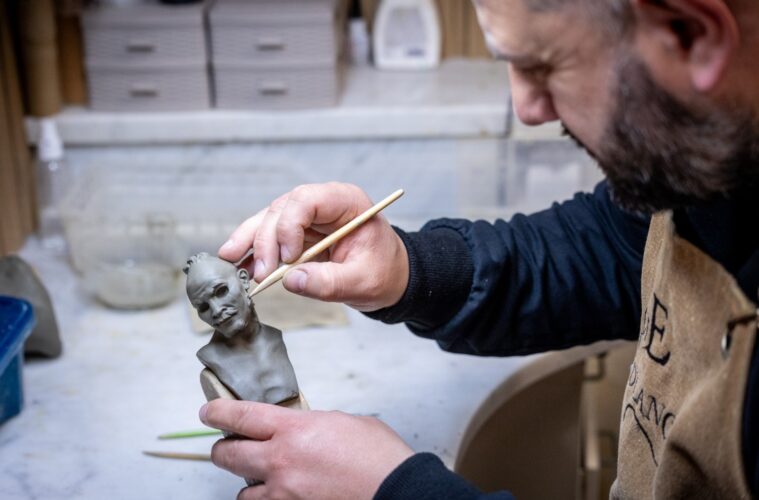
A short walk from the train station in Meta sits the workshop of one of Sorrento’s most well-known nativity scene artisans: Giuseppe Ercolano. Behind the door lie just a few examples of his work: miniature figures, instruments and animals encased in glass display boxes, an image of occurrences and people from centuries ago.
Last Christmas, Ercolano’s artistic genius touched Sorrento in the form of “Giuseppe Ercolano and the Masters of the Nativity,” which he curated—an exploration of nativity art across different mediums, regions and time periods. It made an appearance on Lake Como the previous year.
Giuseppe Ercolano strives to preserve ancient nativity scene artwork from his workshop in Meta
Just a few years prior, the Diocesan Museum in Bavaria, Germany commissioned Ercolano to create what is now one of his most prized artworks: the German nativity scene of King Ferdinand IV of Bourbon, King of Naples. Designing the entire exhibition took more than three months.
“I am very proud of this simply because, being museum quality, it will go down in history,” he said.
These and other projects have made Ercolano a renowned artisan whose work is inspired by the tradition of 18th-century Naples.
“I define myself as a nativity scene artisan rather than an artist simply because everything I create has already been interpreted by great artists,” Ercolano said.
Even in his youth, he was attracted to craftsmanship and quickly struck a passion for the realistic, miniature Neapolitan nativity scene art of the 18th-century Neapolitan school. This historic art form reached its peak during the Bourbon era, when the King and Queen of Naples found a particular interest in creating highly detailed Christmas scenes.
The Process
Nativity scene art is incredibly complex: a mixture of fine details, various materials and lots of time.
“At the beginning, everything seems difficult, and perhaps it is. But let’s just say it’s that touch of courage that sets craftsmanship apart,” Ercolano said. “A typical characteristic of the Neapolitan people is the art of making do.”
Although various mediums contribute to the formation of the nativity scene characters, the process begins with clay. Ercolano starts by modeling the head of the figures, which are baked within a kiln reaching 950 degrees. The figures’ eyes, constructed from glass, are added and the eyelids formed with putty.
He then transitions to working with wood, as is the tradition, to form the hands and feet of the characters.
The core of every figure is made with wire, allowing for versatility in how it can be positioned: sitting down, standing up, crouching, or doing whatever task Ercolano aims to replicate. The small details of the character’s faces are painted.
The final step is the clothes: strictly formed from natural fibers like silk, cotton and linen. Synthetic fabrics like those commonly used in modern-day clothing would puff out and fail to achieve the realistic look that Ercolano seeks to reproduce, one that reflects the traditional customs and clothing of the time period.
His work doesn’t just conclude with the creation of Angels, shepherds or kings. Ercolano also creates animals like sheep and horses. He began with creating animals and said the way he renders the animals’ coats sets him apart from other artisans.
“The market appreciated my work and so today, we’re covering every aspect of the nativity scene, right down to set design,” he said. “I like to be described as an all-around nativity-scene artist.”
Continuing an ancient tradition
Artists like Ercolano strive to keep this tradition alive.
“It is the passion that pushes me to reproduce these works of art,” he said.
His nativity scenes, from angelic figures to shepherds to animals, have been seen across Sorrento and in Vatican City, Naples, Spain and Germany to name a few.
However, with the rise of technology and the tendency for modern artists to embrace it, Ercolano worries that hands-on work and craftsmanship are diminishing.
“We must preserve and naturally safeguard it because it is, after all, a highly underrated artistic asset. Naturally, I am biased but I believe it is something important,” he said.