

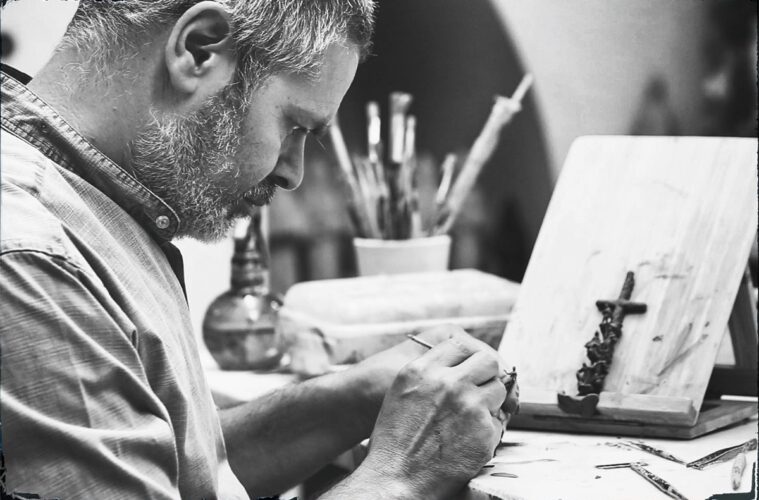
Since the 1400s, in Maiano, Sant’Agnello, Marcello Aversa’s family has been creating terracotta bricks used by the community to bake pizza and bread in wood-fired ovens. Centuries into this family business, Aversa, born in 1966, soon discovered that the same terracotta could create characters.
Today, with the material that for centuries has formed bricks, Aversa now creates sacred scenes from the Old and New Testaments, telling what he calls “stories of heaven on earth” using a stick and pin to model figures as small as eight millimeters. In 2001, Aversa opened an art shop and workshop in Sorrento where his pieces come to life after being fired in kilns that reach over 900 degrees Celsius.
Marcello Aversa went from making bricks in Sant’Agnello to forming nativity scenes in Sorrento
His exhibition, “Terre, Acqua e Fuoco” has sat in his hometown of Maiano since 2007.
His formulation of the Neapolitan nativity scene now appears in several of the churches within the Sorrento Peninsula and have been exhibited at the Sacred Art exhibition in Pompeii, where he was awarded the prize for the best stand two years in a row.
Aversa’s “Lux Familiae” tells the story of the Family of Nazareth and, in 2015, was presented to Pope Francis in Rome during the Synod on the Family. He is deeply connected to his two “Trees of Life” represented by two crosses on which the history of salvation is replicated in terracotta, beginning with the original sin to the resurrection of Jesus Christ, embellished with various Christian symbols. His work has been featured in group and solo exhibitions in cities like Brussels and Naples.
The interview to Marcello Aversa
“I am deeply connected to these works because they required great commitment, even though, for me, being a passion, it was also enjoyable,” Aversa said.
He said that the works take shape in his mind, and rather than being structured, they naturally evolve and change as Aversa moves forward with the project.
“The most difficult part is developing the work, while the easiest part—thanks to 40 years of experience—is actually creating it,” he said. “Of course, there are moments when it becomes harder to proceed, because not every day is the same.”
Despite his numerous achievements, Aversa said he has never considered himself a ceramic artist because he has never attended a school or had a teacher.
“I see myself as a ceramic artist by chance, because I suddenly realized I had the ability to shape these sculptures, and perhaps that is also why I gravitated toward sacred works,” he said.
Today, this chance has made his name synonymous with the art.